An unsafe underground work area. A missing sign-off book. An altered inspection report. And a legal process that took roughly six years — from a 2019 dismissal to a 2026 Labour Court ruling — to finally settle whether that dismissal was fair. The Seriti Coal case is a genuinely instructive one, not because the underlying safety failures are unusual, but because of what it took to get a clear answer on the record.
What Actually Happened
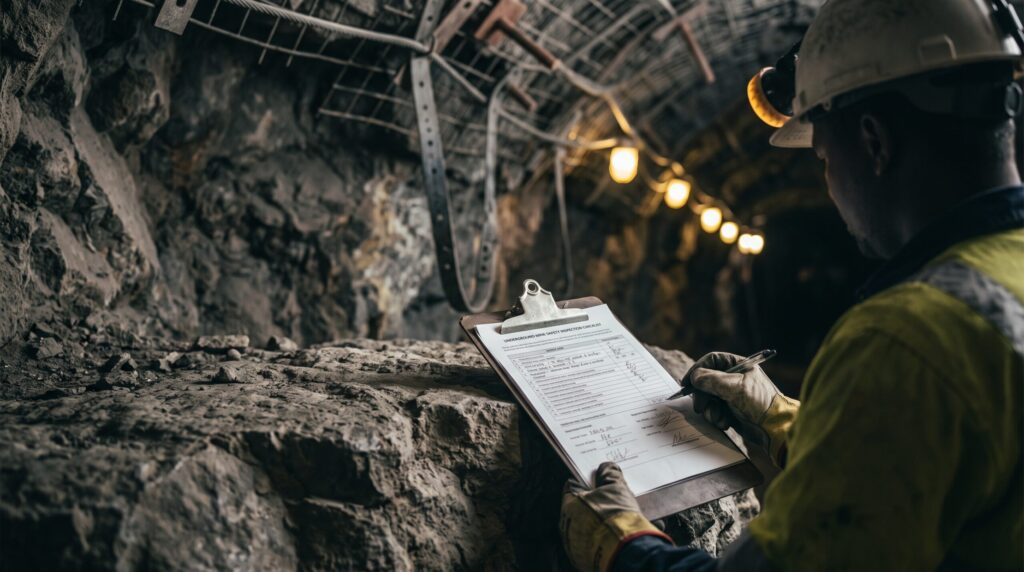
On 3 April 2019, a routine safety audit at Seriti Coal’s New Denmark Colliery uncovered serious deviations in an underground work area known as “Split Thirty-One.” The audit found the area had not been properly supported — critical roof support equipment (Oslo straps) was missing, several roof bolts had not been fitted, and telltale monitoring devices used to detect roof movement were absent. Unsafe areas had not been barricaded. A required support sign-off book was missing entirely.
These weren’t minor paperwork gaps. The deviations were classified as Class A hazards — serious enough that work should not have continued in the affected area until corrected. The mine overseer responsible, Godfrey Rasmeni, was dismissed. According to reporting on the case, he later altered an official inspection report — a separate and more serious act than the original documentation failures themselves.
The Legal Journey — Why This Case Took Six Years
Rasmeni challenged his dismissal. At the CCMA, an arbitrator initially found the dismissal unfair and ordered reinstatement with backpay. Seriti Coal took that award on review to the Labour Court in Johannesburg.
On 18 May 2026, in Seriti Coal (Pty) Ltd t/a New Denmark Colliery v Commission for Conciliation, Mediation and Arbitration and Others [2026] ZALCJHB 147, the Labour Court set aside the CCMA award, finding it unreasonable “in relation to the totality of the evidence,” and substituted a finding that the dismissal was fair. The court’s reasoning was direct: continued employment of someone who treated deviations from safety standards as routine posed a severe operational risk to the employer, particularly given the pattern of misconduct involved, not a single isolated lapse.
Worth noting for context: two other mine overseers implicated in the same incident received different, lesser sanctions — one received a final written warning for failing to sign the shift boss’s logbook daily, without being found guilty of failing to observe and enforce compliance generally; the other was found guilty specifically of failing to install a telltale device recommended by the mine inspector. The court’s finding against Rasmeni specifically turned on the fuller pattern of his conduct, not a blanket “anyone connected to this gets dismissed” standard.
This Isn’t an Isolated Ruling — It’s a Pattern
Two other recent Labour Court and Labour Appeal Court cases reinforce the same underlying principle: South African courts treat safety-related misconduct in high-risk industries, particularly mining, as warranting a materially stricter standard than ordinary workplace misconduct.
In Samancor Limited (Eastern Chrome Mines) v NUM obo Violet Masha, the Labour Appeal Court confirmed that dismissal for a first-time offence of disregarding safety instructions can be justified in mining specifically, given the high risks involved — departing from the general employment-law principle that dismissal should ordinarily be reserved for repeated or especially serious misconduct.
In Association of Mineworkers and Construction Workers Union obo Maethole and Others v CCMA and Others [2026] ZALCJHB 226 (26 July 2026), the Labour Court upheld the dismissal of a group of employees for a “flagrant violation of the Rules of Life” following an incident that resulted in a colleague’s serious injury, explicitly reasoning that conduct carrying a high risk of danger to others’ safety justifies dismissal even where it wouldn’t for lower-risk misconduct.
Read together with Seriti Coal, the pattern is consistent: where safety documentation and procedural compliance genuinely stand between employees and serious harm, South African Labour Courts are not treating that compliance as a formality — they’re treating its breach as conduct that goes to the heart of the employment relationship.
What This Means in Practice
Documentation isn’t paperwork for its own sake — it’s what your legal defensibility is actually built on. If Seriti Coal’s case had turned on a thinner evidentiary record — a less clearly documented audit trail, a less obvious sign-off gap — the outcome could plausibly have gone the other way at review stage. The same appointment-letter and sign-off discipline we’ve covered elsewhere in this series (see our posts on the Construction Regulations’ appointment structure requirements and the General Safety Regulations’ housekeeping provisions) isn’t abstract compliance theatre — it’s the evidentiary foundation a fair dismissal case actually rests on, years later, if it’s ever challenged.
The altered report is arguably the more important fact than the original safety gaps. Genuine safety failures happen. What appears to have made this case defensible on review wasn’t just the underlying Class A deviations — it was the escalation from a documentation gap to what the reporting describes as altering an official record. That’s a different category of conduct, and it’s worth building into any internal disciplinary framework as a clear, separately-treated aggravating factor.
This connects directly to the systemic-vs-individual framing we’ve made the case for elsewhere. Whether a safety failure reduces to one person’s misconduct or reflects a genuinely systemic gap is rarely a clean either/or — this case shows both at once: an underlying system that was, in fact, catching the problem (the audit worked, the Class A classification worked), and an individual response to that finding that made things materially worse.
The Bottom Line
Six years between a dismissal and a final, binding answer on its fairness is a long time to carry legal uncertainty — and it’s a direct function of how much the outcome depended on the quality and completeness of the documentary record built at the time, not years later. If your organisation’s safety documentation, sign-off processes, and appointment structures aren’t currently built to survive that kind of scrutiny, that’s the gap worth closing now, while the record can still be built properly — not years into a dispute you didn’t see coming.
This is a commentary piece, connecting directly to AOAL’s regulatory series on South African HSE legislation under the OHS Act.
Not sure whether your current safety documentation, sign-off processes, and appointment structures would hold up to this level of legal scrutiny? Most companies don’t know where to start. AOAL Consulting Services is offering a free virtual gap analysis of your legal register. No cost, no obligation.
This article is for general information purposes and does not constitute legal advice. It reflects publicly reported facts of the case as available at the time of writing; AOAL has not reviewed the full judgment or underlying record independently, and readers relying on the specifics for their own legal position should consult the full judgment via SAFLII directly.
References:
Seriti Coal (Pty) Ltd t/a New Denmark Colliery v Commission for Conciliation, Mediation and Arbitration and Others (JR940/2020) [2026] ZALCJHB 147 (18 May 2026). Available at: https://www.saflii.org/za/cases/ZALCJHB/2026/147.html (Accessed: 16 September 2026).
Association of Mineworkers and Construction Workers Union obo Maethole and Others v Commission for Conciliation Mediation and Arbitration and Others (JR1299/23) [2026] ZALCJHB 226 (26 July 2026). Available at: https://www.saflii.org/za/cases/ZALCJHB/2026/226.html (Accessed: 16 September 2026).
Webber Wentzel (2026) Labour Appeal Court Ruling Underscores the Importance of Safety in Mining. Available at: https://www.webberwentzel.com/News/Pages/labour-appeal-court-ruling-underscores-the-importance-of-safety-in-mining.aspx (Accessed: 16 September 2026).
Mining Zimbabwe (2026) SA Mine Manager’s Dismissal Upheld After Failing to Enforce Safety Standards. Available at: https://miningzimbabwe.com/sa-mine-managers-dismissal-upheld-after-failing-to-enforce-safety-standards/ (Accessed: 16 September 2026).
Joburg ETC (2026) Labour Court Upholds Seriti Coal Overseer Dismissal. Available at: https://www.joburgetc.com/news/labour-court-upholds-seriti-coal-overseer-dismissal/ (Accessed: 16 September 2026).
Occupational Health and Safety Act 85 of 1993. Pretoria: Government Printer.