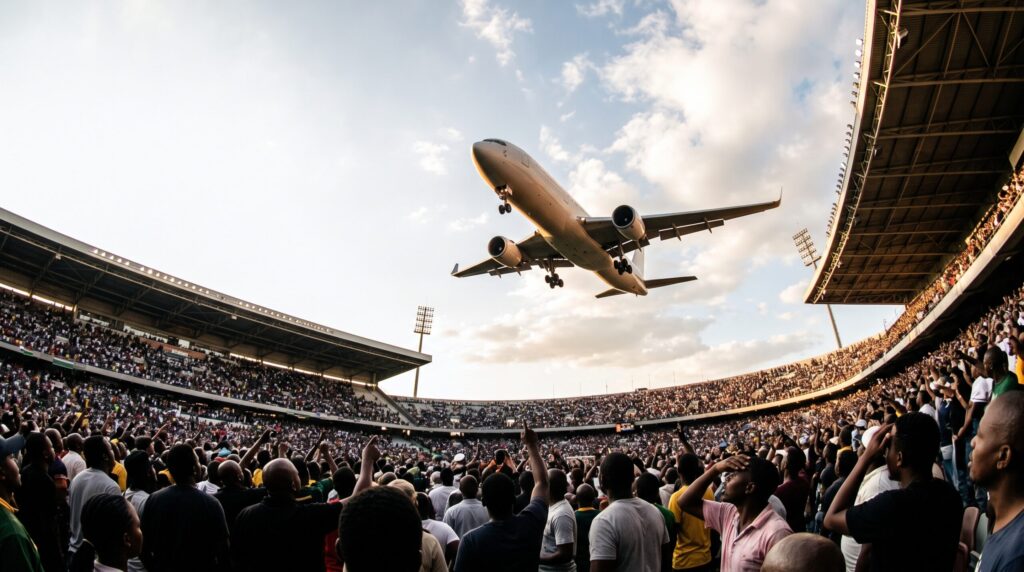
Two Airlink Embraer E-Jets passed within an estimated 12–14 metres (41 to 46 feet) of Cape Town’s DHL Stadium ahead of the Springboks–All Blacks test — FlightRadar24’s own flight-tracking analysis puts the lead aircraft’s clearance in that range — and the footage did exactly what viral aviation footage always does — split opinion instantly between “incredible piece of flying” and “someone needs to explain how this was ever approved.” The South African Civil Aviation Authority (SACAA) has opened a compliance investigation, obtained flight data recordings from both aircraft, and confirmed Airlink has withdrawn its remaining planned flyovers for the series. This isn’t our usual OHS Act territory — SACAA operates under separate aviation legislation — but the regulatory behaviour on display here is worth a closer look, because it’s a pattern we recognise.
What’s Actually Happening, Not What the Headlines Suggest
Strip away the viral-video framing and SACAA’s actual statement is fairly measured: it says it has “initiated compliance verifications, engaged the operator, obtained the Flight Data Recording downloads as well as other additional requirements,” and that “it is therefore critical that we interrogate this past weekend’s events… to determine if there were any safety concerns which warrant a review.” A full report with recommendations will follow once the assessment is complete — no timeline given.
Airlink, for its part, maintains the flights were performed within SACAA’s own approved and rehearsed safety parameters for a Special Air Event, at roughly 150 knots (278 km/h), with a three-person crew including a dedicated safety/technical officer per aircraft. The carrier withdrew its subsequent planned flyover citing unrelated weather conditions, and separately dropped the Soweto flyover once scrutiny intensified. SACAA itself has pointed to South Africa’s clean safety record in its public comments, noting the country has “0 percent record in fatal accidents in the commercial airline operations space for over four decades” — a record it says it intends to uphold.
How This Compares to Standard Minimum Safe Altitude Rules
Special Air Events operate under their own approved parameters, distinct from everyday flight rules — but it’s worth knowing what the everyday baseline actually is, since it puts the scale of the exemption in context:
- ICAO’s general Minimum Safe Altitude (MSA) above the highest obstacle is 150 feet (46 metres)
- The FAA’s minimum safe altitude rule requires 1,000 feet (300 metres) above the highest obstacle within a 2,000-foot (600-metre) horizontal radius when flying over congested areas
- New Zealand’s equivalent rule (Civil Aviation Rule 91.311) requires at least 1,000 feet (300 metres) above the surface or any obstacle within a 600-metre horizontal radius of a congested area or open-air assembly of people — a rule a former New Zealand CAA spokesperson specifically cited when asked to comment on this incident, while declining to weigh in on South African airspace directly
Special Air Events are explicitly designed to operate outside these everyday minimums, under their own approval framework — SACAA’s Special Air Events Handbook sets out the actual approval and display-authorisation categories used for events like this one. That framework exists precisely because flying this close to the ground and to crowds is understood to be a meaningfully different risk category from routine flight — which is exactly why the informed-consent question below matters as much as it does.
In other words: an approved event, under investigation, with data already collected and no findings yet released. That’s a normal, unremarkable regulatory process so far. What’s notable is what tends to happen next.
A Question of Informed Consent
Here’s where this stops being just a regulatory-timing story and becomes a genuine safety-management one, and it’s worth stating plainly: the more than 56,000 people inside DHL Stadium that day had no opportunity to consent to the risk they were exposed to.
This is a principle AOAL deals with constantly in occupational and public safety contexts, and it applies just as directly here. When someone bungee jumps, they sign a waiver — they’ve been told the specific risk, and they’ve chosen to accept it. When you stand near a big cat enclosure at a zoo, there’s a warning sign — the risk is disclosed, and you decide whether to stay at the rail or step back. That’s the entire basis of informed consent to risk: the person exposed gets to make the call, because they’ve actually been told there’s a call to make.
Nobody in that stadium was told two commercial jets would pass within 15 metres (50 feet) of their heads that day. Whether the flyover was safely executed or not — whether any fault ultimately lands with the regulator’s approval process or the flight crew’s execution — is a separate question from the one that actually matters to the people who were there: they were exposed to a risk they never agreed to, because they were never told about it. A stadium ticket is consent to watch a rugby match. It is not consent to an unannounced low-altitude flypast, however skilfully flown.
To be fair to all sides: flyovers have been a fixture of South African rugby since the 1990s, and it’s plausible most attendees assumed something routine and pre-cleared was happening overhead, the way people generally assume aircraft near a stadium are operating safely by default. That assumption is exactly the problem — it substitutes for actual disclosure, and this incident is a reminder that the two aren’t the same thing.
Our Read: Don’t Expect a Statement Any Time Soon
Here’s our prediction, offered as analysis rather than inside information: SACAA is unlikely to issue a substantive public statement while this story still has media heat behind it. Regulators facing a viral, emotionally charged incident have little to gain from commenting while public opinion is polarised and every word will be parsed for which “side” it favours. The more likely pattern: a period of public quiet — weeks, more plausibly months — followed eventually by a formal finding or report released once attention has genuinely moved on, framed procedurally rather than as a response to public pressure.
We’re not guessing blind on this. It’s a pattern we’ve documented directly in our own regulatory series this year. South Africa’s Draft Regulations for Hazardous Chemical Agents went to public comment in mid-2024, that comment period closed in July 2024, and as of this writing — more than two years later — nothing has been finalised, with no public update in between. The pattern isn’t unique to aviation, and it isn’t unique to this incident. Regulatory bodies here have a demonstrated tendency to let scrutiny cool before committing anything to writing, on subjects far less viral than a jet clearing a packed stadium by 50 feet.
What This Means in Practice — For Organisations, Not Just Regulators
The genuinely useful takeaway here isn’t about aviation. It’s about how any organisation — yours included — should think about the gap between an incident happening and a regulator’s formal response landing.
Don’t wait for the regulator’s timeline to set your own. If something happens on your site that draws scrutiny — an incident, a near-miss caught on someone’s phone, a compliance question raised publicly — the investigating body’s silence is not a signal that the matter is resolved or forgotten. It’s far more often a signal that the finding is still coming, just later and quieter than the incident itself.
Internal review shouldn’t wait for external findings. Airlink’s own posture — asserting the flight was within approved parameters while cooperating with the investigation — is the right instinct: address it directly, keep operating within what’s actually authorised, and don’t let the absence of a regulatory statement become an excuse to treat the matter as closed internally.
A quiet regulator is still an active one. The FDR downloads are already in SACAA’s hands. Whatever the eventual report says, the evidence base for it was captured immediately, not reconstructed later. The same is true of any HSE investigation your organisation might face — the absence of a public update doesn’t mean nothing is happening.
Disclosed risk and assumed risk are not the same thing, and treating them as interchangeable is a real liability. If your organisation exposes anyone — workers, visitors, the public — to a foreseeable hazard, the informed-consent principle applies regardless of how skilfully the hazard is managed. A well-executed risk is still an undisclosed one if the people exposed to it were never told. That gap is exactly where liability tends to concentrate after the fact.
The Bottom Line
This will very likely follow the shape we’ve seen elsewhere in South African regulatory practice this year: an immediate flurry of public attention, a measured initial statement, meaningful investigative work happening quietly in the background, and then — eventually, once the news cycle has moved on — a formal finding that gets a fraction of the coverage the original incident did. Worth watching for, if only to confirm the pattern holds. And whatever that finding says about safety margins and approvals, it won’t change the fact that on the day, the people in the stands never got a say.
This is a commentary piece, separate from AOAL’s regulatory series on South African HSE legislation under the OHS Act. Our predictions about SACAA’s likely timeline are our own analysis, not confirmed information from the regulator.
If your organisation is navigating the gap between an incident and a regulator’s formal response — in HSE specifically, our actual area of practice — AOAL Consulting Services can help you think through what to do in that interim period, not just after a finding lands.
Join our subscribers
Stay in the loop with everything you need to know regarding Quality, Health, Safety, and Environmental (QHSE) and legal compliance consulting services in South Africa.
References:
Associated Press, via ABC News (2026) South Africa Aviation Regulator Probes Low Jet Flypast Over Cape Town Stadium. Available at: https://abcnews.com/International/wireStory/south-africa-aviation-regulator-probes-low-jet-flypast-136147456 (Accessed: 14 September 2026).
FlyingMag (2026) South African CAA Investigating 50-Foot Stadium Flyover. Available at: https://www.flyingmag.com/south-africa-caa-airlink-stadium-flyover-50-feet/ (Accessed: 14 September 2026).
Flightradar24 (2026) Airlink’s Low Flypast Over Rugby Match in Cape Town. Available at: https://www.flightradar24.com/blog/flight-tracking-news/special-event/airlinks-low-flypast-over-rugby-match-in-cape-town/ (Accessed: 14 September 2026).
NZ Herald (2026) All Blacks v South Africa Jet Flyover in Cape Town: ‘The Aircraft Were Too Low’ — Experienced Kiwi Aviator. Available at: https://www.nzherald.co.nz/sport/rugby/all-blacks/rugby-all-blacks-v-south-africa-jet-flyover-in-cape-town-the-aircraft-were-too-low-experienced-kiwi-aviator/premium/YOECIWP6BNGZNJLPUAJMKZBAFI/ (Accessed: 14 September 2026).
South African Council for Aviation Recreation (n.d.) The South African Special Air Events Handbook. Available at: https://www.airshowsa.org.za/airshows/docs/SAE%20HANDBOOK%20240221%20N%20.pdf (Accessed: 14 September 2026).
Yahoo News, via Yahoo Scout (2026) South African CAA Investigating 50-Foot Stadium Flyover. Available at: https://www.yahoo.com/news/world/articles/south-african-caa-investigating-50-203000217.html (Accessed: 14 September 2026).
Tags: SACAA, Airlink flyover, DHL Stadium, civil aviation South Africa, informed consent risk, Special Air Events South Africa, minimum safe altitude, regulatory investigation South Africa, risk communication, public safety disclosure